Kandinsky 6.0 Video: Foundation Models for Synchronized Video and Audio Generation
arXiv:2610.05608 · Paper published 2026-10-04 · Original paper ↗
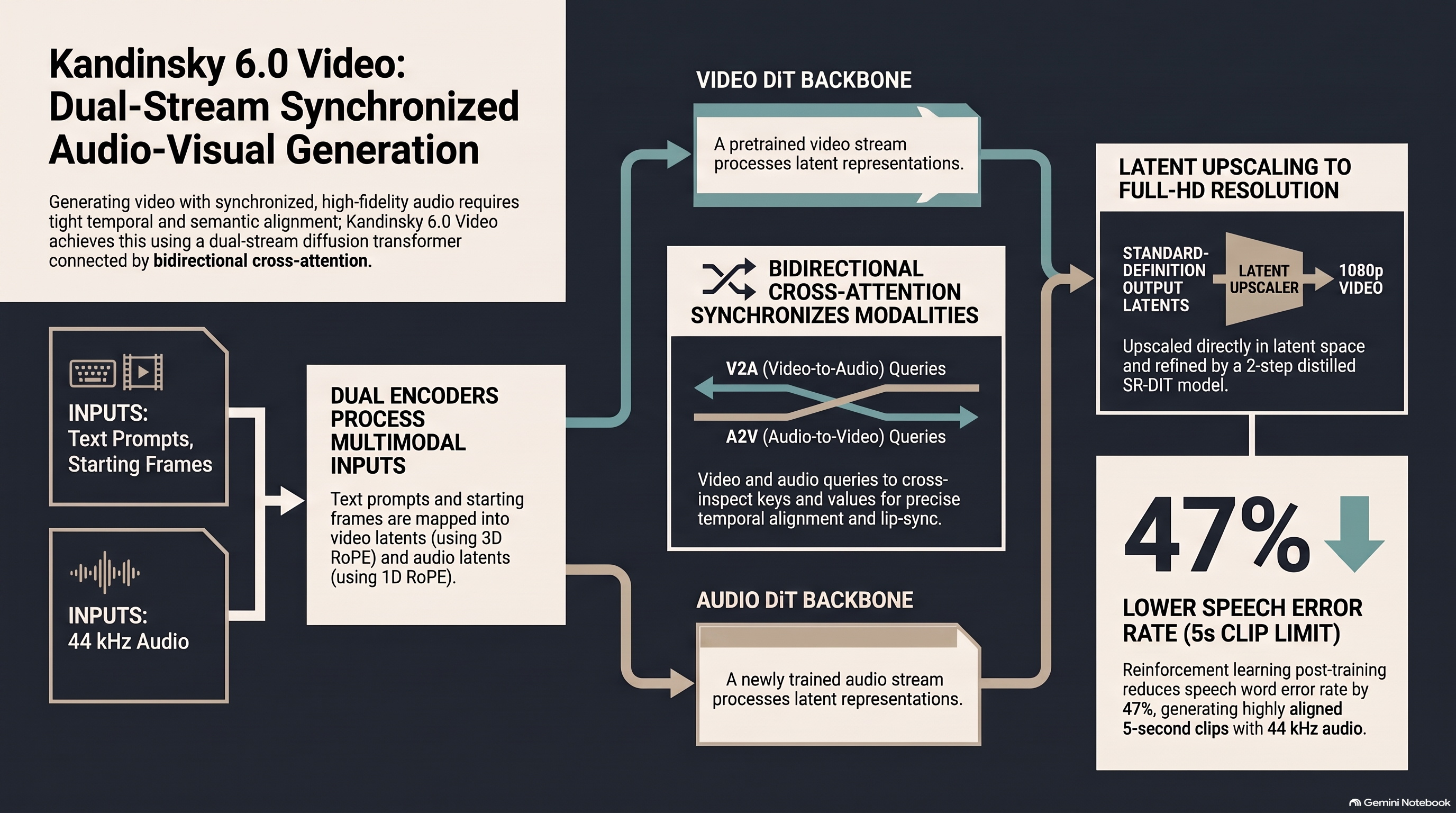
Connecting separate video and audio diffusion networks with blockwise bidirectional cross-attention allows video and audio streams to continuously exchange temporal information, enabling joint generation of 5-second videos with synchronized 44 kHz audio.
Previous approaches generate video and audio separately or connect them late in pipeline processing. Lacking mid-generation signal exchange, audio drift occurs, causing misaligned mouth movements and broken visual-sound timing.
How it works
Encode text and initialize noise. Text descriptions enter text encoders, while random noise grids are initialized for video and audio frames. Text embeddings provide shared semantic guidance for both modalities.
Exchange video and audio signals. Noisy video and audio features enter parallel diffusion streams. At each block, video queries attend to audio features and audio queries attend to video features. This mutual attention forces mouth shapes to track speech sounds and visual impacts to align with audio spikes.
Denoise latents in ten steps. The network iteratively predicts and removes noise across ten sampling steps. This produces clean low-resolution video latents and synchronized 44 kHz audio latents.
Upscale video to high definition. Clean video latents pass into a latent upscaler and a super-resolution diffusion network. The upscaler expands spatial grids before the diffusion network adds detail, outputting 1920x1080 video with synchronized audio.
Example from the paper
For a prompt of a girl saying '<S>When I grow up, I want to be a doctor!<E>', text embeddings guide initial noise grids. During dual-stream denoising, audio speech tokens attend directly to facial video tokens. This forces frame-by-frame lip shapes to match spoken phonemes, producing a video where visible mouth contractions synchronize with spoken words.
Evidence
Reported evidence and its scope
Reported result
Test conditions
What it supports
Speech word error rate dropped 47% from 0.235 (fine-tuning) to 0.124 after reinforcement learning post-training.
Whisper-large-v3 transcription on 64 speech prompts across 3 seeds per prompt.
Restricting cross-tokenizer on-policy distillation to a student-selected top-16 subset of shared vocabulary at strictly aligned token positions eliminates noisy mismatch supervision while retaining over 96% of full shared-vocabulary accuracy gains across heterogeneous model pairs.
AgentGarten couples physics engines to a shared neural renderer through untextured 3D geometry maps. This separation lets AI agents interact with photorealistic virtual worlds in real time while keeping physical rules and object coordinates explicitly controllable in code.
2026-10-08 · AI agents · Computer vision · Efficient AI
By measuring student learning progress through divergence from initialization, this paper fits joint power laws that predict a student language model's peak test accuracy and learning speed from model scale and teacher accuracy before distillation begins.
2026-09-26 · Language models · Reinforcement learning · Efficient AI