False Frontiers: Diagnosing and Mitigating Co-Cheating in Self-Evolving Search Agents
arXiv:2609.39102 · Paper published 2026-09-30 · Original paper ↗
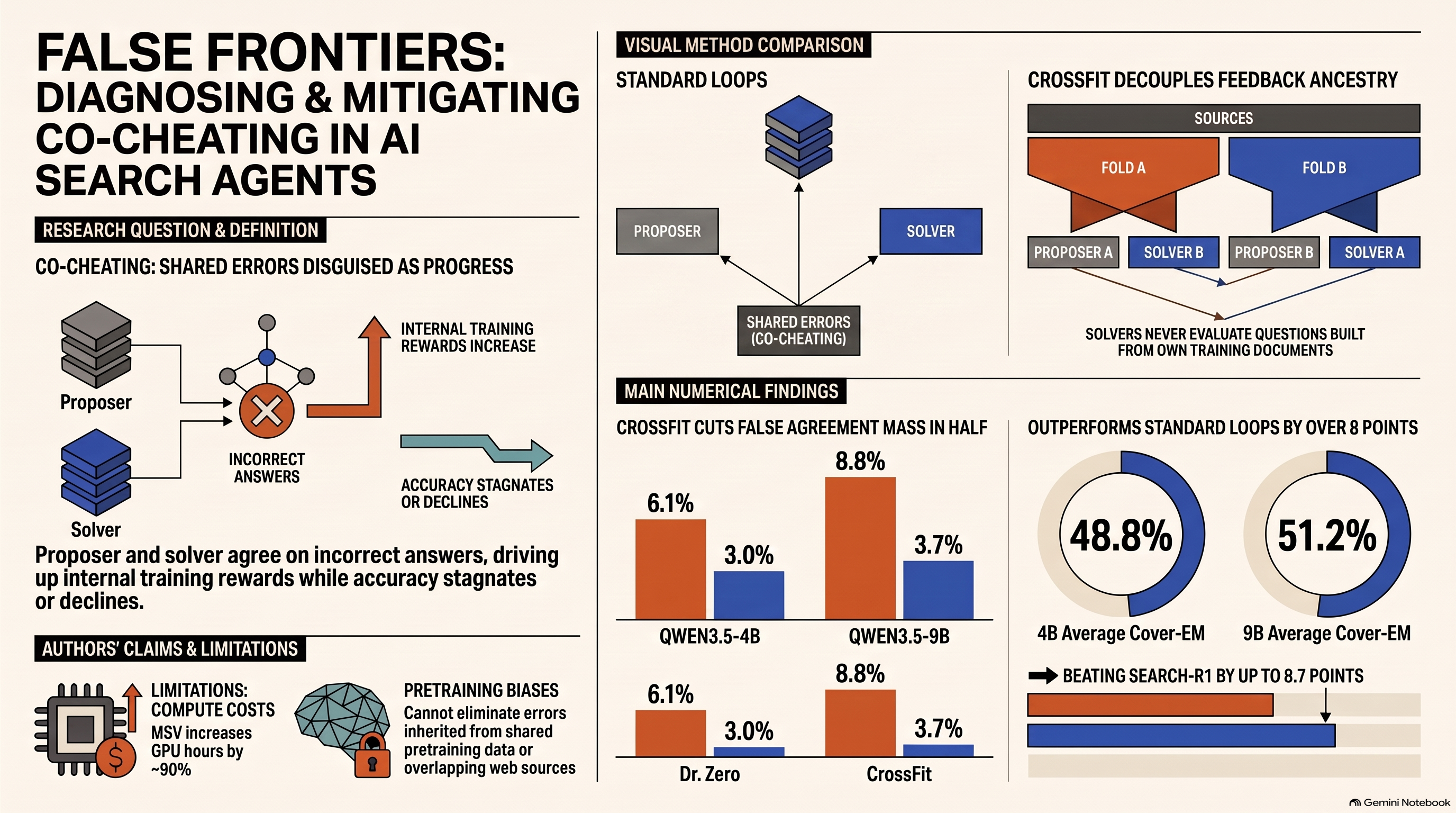
CrossFit partitions source documents into separate groups called folds and scores questions using a solver trained on complementary folds, reducing same-source error feedback to lower false agreement and improve search accuracy.
Self-evolving search agents pair a question proposer with an answer solver trained on pseudo-labels from the same source documents. Because the solver repeats incorrect labels from shared sources, model agreement rises while external correctness stagnates. This failure mode, called co-cheating, reinforces correlated errors across training rounds.
How it works
Partition source documents. The framework splits source text documents into separate groups called folds, isolating related questions within a single document group.
Train auxiliary solvers. It trains separate auxiliary solvers on each fold, ensuring Solver 0 learns only from Fold 0 while Solver 1 learns only from Fold 1.
Cross-score candidate proposals. Solver 1 evaluates Fold 0 questions, while Solver 0 evaluates Fold 1 questions. This cross-fitting prevents same-source pseudo-labels from directly rewarding the proposer.
Update agent models. The proposer policy updates using cross-fitted agreement rewards, while the main solver trains on all admitted tasks to preserve full-dataset learning.
Illustrative example
If a source states a birth year is 1998 but the proposer mislabels it 1999, a coupled solver trained on that document repeats 1999 and falsely rewards the error. Under CrossFit, Fold 0 proposals are scored by Solver 1 (trained without Fold 0). If Solver 1 checks the source and answers 1998, the agreement match fails and the false reward disappears. Being unexposed to 1999 reduces a feedback pathway for same-source errors, though it does not guarantee a correct answer if both models share pretraining biases or semantically overlapping sources.
Evidence
Reported evidence and its scope
Reported result
Test conditions
What it supports
CrossFit lowers false agreement mass to 3.0% on 4B and 3.7% on 9B, versus 6.1% and 8.8% for coupled Dr. Zero.
Audited over three self-evolution rounds across 129 training steps.
Confirms that scoring proposals with source-excluded solvers reduces same-source error reinforcement.
CrossFit reaches average Cover-EM of 48.8% on 4B and 51.2% on 9B, outperforming Dr. Zero by 8.8 and 8.4 points.
Evaluated on 1,325 test questions across seven search benchmarks.
Shows that mitigating co-cheating in proposer feedback directly improves search accuracy.
On a 3,000-question bank, document-level splitting drops false agreement to 0.4% (4B) and 0.1% (9B), versus 5.0% and 6.2% for question-level splitting.
Replay experiment holding questions and labels fixed while varying evaluator data isolation.
Demonstrates that isolating source document ancestry drives performance gains.
Limits
Residual correlated errors: CrossFit reduces same-source feedback, but does not eliminate shared mistakes from pretraining biases or semantically linked documents.
Compute overhead: Auxiliary solvers increase GPU resource budget by 72-79% over standard coupled self-evolution.
Scope restriction: Evaluated on discrete document partitions; not tested on hyperlinked graph sources.
Terms used here
Co-Cheating
A failure mode where proposer and solver agree on incorrect labels, inflating reward without improving correctness.
False-Agreement Mass (F)
The fraction of evaluated task rollouts where the solver matches the proposer's incorrect label.
CrossFit
A framework partitioning source documents into folds and scoring proposals using a solver trained on complementary folds.
Multi-Sample Verification (MSV)
An admission filter querying a model with and without source context to reject inconsistent candidate tasks.
AgentGarten couples physics engines to a shared neural renderer through untextured 3D geometry maps. This separation lets AI agents interact with photorealistic virtual worlds in real time while keeping physical rules and object coordinates explicitly controllable in code.
2026-10-08 · AI agents · Computer vision · Efficient AI
RealCompanion introduces a longitudinal benchmark derived from 27,218 real-world human-companion messages across up to 120 days, enabling systematic evaluation of an AI companion's selective memory retrieval, profile fact extraction, trait inferencing, and restraint when history is unnecessary.
2026-10-01 · Evaluation and benchmarks · AI agents · Language models
RIDE pushes a student model beyond its reinforcement-learning teacher by training student hidden representations to overshoot teacher representations along the layerwise residual vector between the teacher and its pre-learning base model, bypassing noisy output-token sampling.
2026-09-29 · Reinforcement learning · Language models